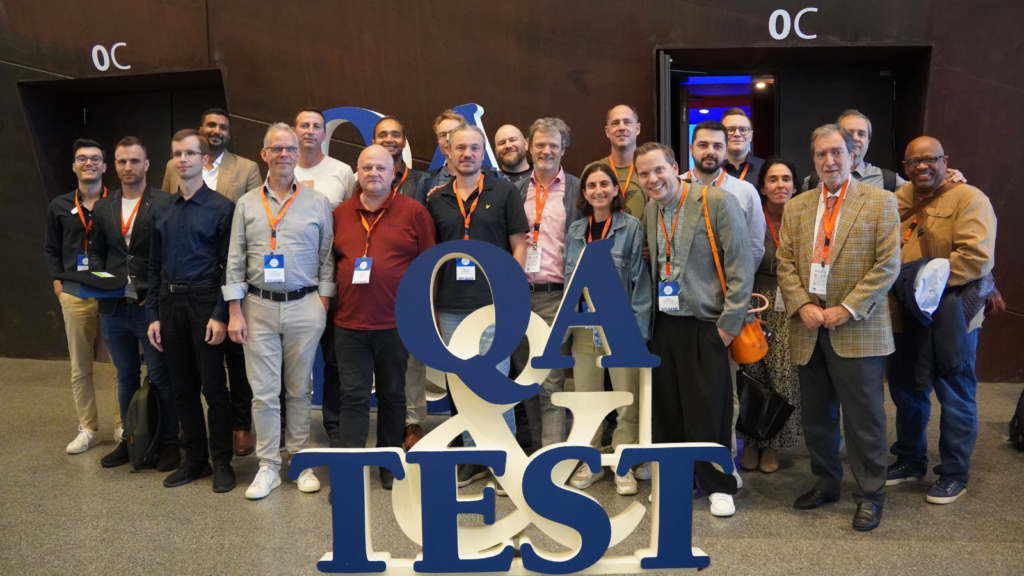
Being invited to present at the 23rd edition of the QA&Test Embedded conference was both a professional milestone and a personal challenge for me. It has been 3 years since I was able to attend the online edition of the conference and it has been my dream since then to go to Bilbao, Spain, and become a part of the event that brings together some of the world’s leading minds in the field of quality assurance and embedded systems testing. Not only that, I was also about to become a speaker at my first international conference! Sounds scary, right? Thankfully, I very quickly learned that one of the conference’s distinguishing factors, besides technical excellence, is a unique atmosphere of support, friendliness, and feedback that is cultivated by the organizers and all attendees.
Held in located at the side of the Nervión River contemporary building of Euskalduna Palace in Bilbao, the conference focused on three main areas: artificial intelligence, sustainability, and cutting-edge techniques in both testing and test automation. The environmental safety aspects of testing and quality assurance were especially highlighted this year and reflected in the organizers’ holistic approach that integrates sustainable practices not only in logistics but also in event content. It resulted in obtaining a prestigious Erronka Garbia certification from the Basque Government as a Green Conference, which deserves recognition!
Day 1
I honestly wish that I would be able to be at two places at the same time during the conference because there were so many great presentations and ideas shared during the talks. But having to limit myself to one activity at a time, I started the first day of the event by going to a Threat modeling workshop hosted by Dan Horovitz. I met Dan just outside the hotel that morning and we had a very pleasant short conversation, but later he proved not only to be a very nice person but also a top-tier professional when it comes down to playing on the defense side in the cybersecurity area. We went through various aspects of threat modeling in a very practical manner, by analyzing potential threats in an IoT device. I found the workshop to be both approachable and comprehensive at the same time, which gave a very strong foundation to everyone who would wish to explore this topic further.
Another highlight of the day for me was a presentation by Dirk Coppelmans on testability aspects in legacy systems. If there’s one topic that we are not talking enough about, then for me it’s surely this one! I work in an industry where a product’s lifetime is often over 20 years, so you can imagine how challenging it could be to deal with a situation where the new technology does not fit the old one, or it simply gets so outdated that nobody really understands it. But Dirk also provided great solutions to deal with such problems through the alignment of refactoring and testing strategies. And what an exciting way to finish the first day it was to learn from a passionate Daniel Moka who evangelized us on test-driven development and mutation testing!
The Green AI
The second day of the conference welcomed us with beautiful, sunny weather, and another set of inspiring presentations. It would require a more skilled writer than me to elaborate on all the brilliant ideas that were shared, but I would like to focus on the artificial intelligence track. AI can be used as a tool to aid testing, but testing AI-based systems also comes with a lot of specific challenges. I really liked the Bugle tool that was presented by Daniel Nilsson and Mert Yurdakul from Test Scouts. Daniel is a seasoned speaker at the QA&Test conference, but for Mert, it was also an international debut so I really cheered for him. It turned out to be unnecessary because Mert’s enthusiasm and technical expertise had driven him through the presentation smooth as warm butter. Speaking of the Bugle tool, it helps testers find duplicate defects in the system, which I found really helpful by saving both time and effort. Vasilios Danos in his presentation switched the perspective to AI-based systems as our test subjects, focusing on robustness, adversarial attacks, data poisoning, information leakage, and prompt injections. He pointed out that formal verification of AI is almost unfeasible and it requires a systematic approach that will extend the common testing strategies used for embedded systems to deal with that issue. There’s still a lot to explore in this area, the same as with AI-aided testing, for example: how to test a deterministic embedded system with a non-deterministic tool such as AI? I think that whoever will find an answer to that question will surely make a huge breakthrough in testing.
But there was also one keynote speech that day that made a tremendous impact on how I see the future of testing. Bahareh Mohajer, QA Lead at IKEA, shared her life story and a deep desire for sustainable innovation and green AI. I learned that it’s the responsibility of everyone in tech to care about our planet, our environment, and the future of our children. In pursuit of new technologies, and increased computing power, we have to remain conscious of energy efficiency, innovation, responsible consumption and production, and other sustainable development goals. Coming from an industrial region of Silesia in Poland, where the mining industry, factories, traffic, and coal heating systems have caused extreme levels of air pollution, I believe that this change can happen and it makes me proud to be a part of a company that built a variable frequency drives testing laboratory here in Katowice that is able to regenerate energy back to the grid.

Leaving the conference aside for a little bit, I would also like to mention that all attendees have been invited to the historical Bilbao Society club headquarters for an amazing dinner. The building had a unique atmosphere and being able to learn more about the Bilbao historical background was an absolute pleasure. It was also a great opportunity to network with both the speakers and the audience.
Going on Stage
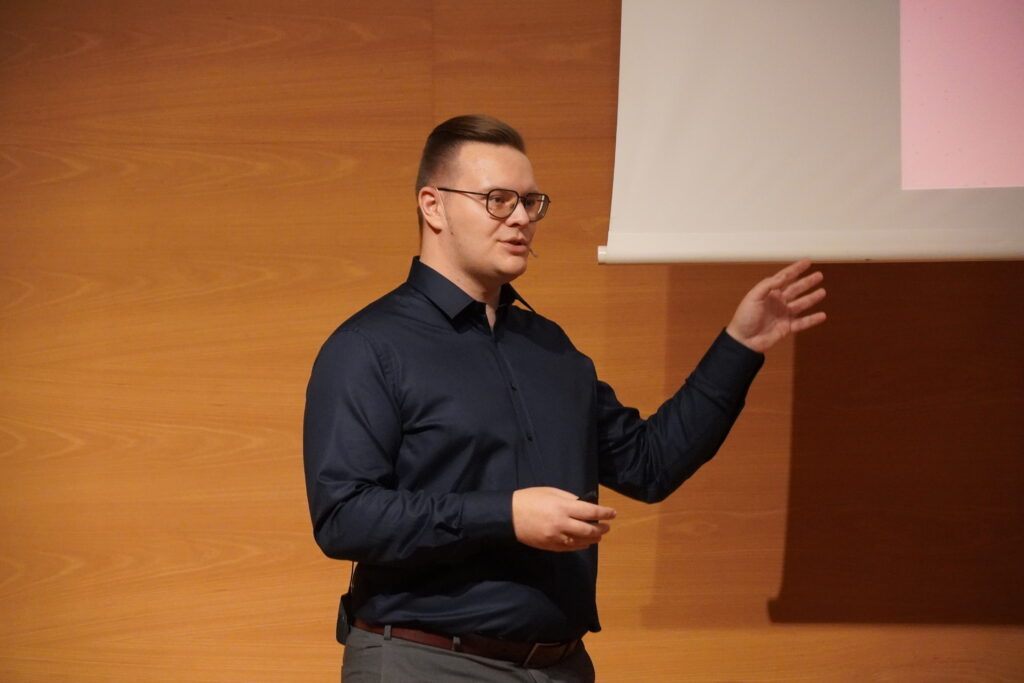
On the third and last day, it was my turn to present and have a big honor to open the Test/QA Management track. It definitely made it easier for me to already get familiar with all the wonderful attendees and to be introduced to the stage by the phenomenal Begoña Laibarra. I spoke about a practical system for optimizing the testing effort based on one of the most challenging projects that I was leading as a test project manager – the Armor PowerFlex. If you would like to learn more about it, then you can start by reading my article about Exploratory Testing, which is one of the key elements for intelligent effort in testing. I also deeply enjoyed Michał Buczko’s talk about quality dashboards and his philosophy on testing metrics and KPIs. Making data-driven decisions based on metrics is something that I find as a fundamental aspect of every successful testing system or strategy and one of the SMART Testing principles, so I was really excited to learn new things from Michał. The conference was concluded by a special lecture by Benjamin Jurg, who also shared a very helpful, AI-based tool called Amarula. It acts as a smell detector – helps in reading reports and looking for any inconsistencies or indications of issues for audit purposes. That was not only a brilliant speech, but also a very entertaining and insightful ending of the event.
This coverage wouldn’t be complete without mentioning the beauty of the city of Bilbao. It has been a feast of architectural, culinary, and artistic experiences, starting with the amazing city landscapes of Abando and Casco Viejo districts, wonderful restaurants and food, and finishing with ecstatic Fine Arts and Guggenheim’s museums. I also really enjoyed staying at the Carlton Hotel, which previously was the headquarters of the first Basque Government and offered excellent hospitality.
What I’ve Learned
Lastly, I would like to share some lessons learned from being a first-time international conference speaker that I hope will encourage you to try your hand at it. They are, in fact, applicable to any public speaking event. I think that the key element of success lies in overpreparing yourself. I put many hours of work into developing visually attractive slides that will highlight all the key points of the presentation. During the last five weeks before the conference I practiced for one hour every day and recorded myself or presented in front of my wife or my coach. I also arrived earlier before my speech to check my slides (I had a hard copy on a flash drive with me just in case), to make sure that I had a glass of water nearby, and to set up the microphone with the aid of technical staff. It sounds like a lot of work and I won’t lie that it’s easy, but by following a similar system, I believe that you will be successful too! Remember that the most important thing is to enjoy yourself on the stage and show your passion and enthusiasm about what you are presenting! And make sure to get to know other speakers and the audience, those relationships, exchange of ideas, support, and feedback are priceless. Did I do everything perfectly? Surely no! But for the next time, I’ll practice more and more to get better. 🙂
I loved every minute of being at the QA&Test Embedded 2024, both learning and sharing, and I am also extremely grateful for the top-tier organization that has been provided by Silvia Nuñez and the SQS team. Everything was just perfect and I am impressed by the amount of work that must have required. It was a pleasure to connect with all the tech geniuses there and I am looking forward to coming back as soon as possible! The conference was also a great reminder of how far the field of embedded systems testing has come – and how far we still have to go. With AI, sustainability, and more advanced testing techniques, human intuition, and critical thinking will still be an important aspect but it has to embrace new challenges and improve every day to get to keep up the pace. If there’s one message I took away, it’s that sustainable and efficient testing is not just a trend – it’s the future of embedded systems testing. As a community, we have to adapt and ensure that we develop our systems not only high-quality but also to last and support the environment.